Utah has more avalanche course options than most people realize, and the wrong starting point wastes a weekend and six hundred dollars. An AMGA guide walks through the whole progression: what each course covers, which Level 1 to pick, and what to take before any of them. Our courses are A3 Recognized courses in the Wasatch, taught by working AMGA and IFMGA certified mountain guides. Two to four students per instructor.
By the guide staff at Wasatch Mountain Guides · A3 Recognized Course Provider
Every year around the first real storm, we get some version of the same email. Somebody has skied Utah resorts for a decade or two, finally bought a touring setup, and wants to know whether they need an avalanche course before they use it. Usually the question is phrased as if the answer might be no.
The answer is yes, and the more interesting question is which one, and in what order. There are more options than people realize, and the wrong starting point wastes a weekend and six hundred dollars.
So here’s the whole picture: what each course covers, who it’s for, what to take before it, and how to tell the difference between a course that certifies you and a course that just teaches you something. We run all of these in the Wasatch, and most of what follows comes from watching which students show up ready and which ones spend day one fighting their bindings.
A course doesn’t make the mountains safer. It makes you someone who can tell which part of the mountain is safe today. That’s a different product than most people think they’re buying.
Not sure where you land? Tell us what you ski and how long you’ve been touring, and we’ll point you at the right course.
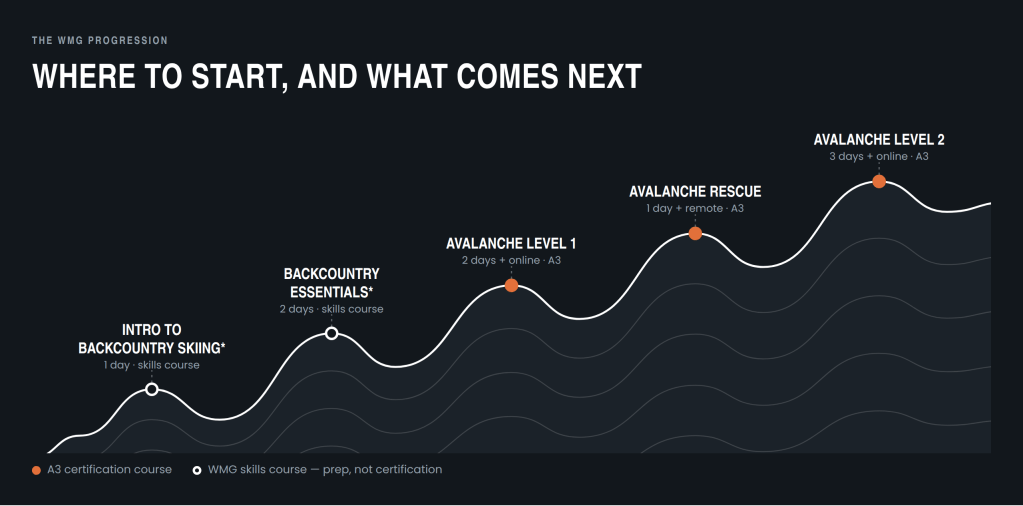
The American Avalanche Association, which most people just call A3, sets the recreational progression in this country: Avalanche Level 1, then Avalanche Rescue, then Avalanche Level 2. We’d add two rungs below that for anyone who hasn’t toured much, because the biggest predictor of how much someone gets out of Level 1 has nothing to do with avalanches.
Where to start and what comes next. Orange stops are A3 certification courses; the open circles are skills courses that prepare you for them.
Each step does one job:
Level 1 teaches you to recognize avalanche terrain and stay out of it when the day says to.
Avalanche Rescue teaches you what to do the day that fails.
Level 2 teaches you to read the snowpack yourself and make calls other people can follow. It only makes sense once you’ve got real field days behind you to test against.
People sometimes ask to take Rescue first, on the theory that they’d rather learn the emergency skills. We push back on that. Rescue is the day you practice for the worst outcome, and it lands much harder when you already understand how someone ends up there. Take Level 1 first.
And if you’ve never toured, don’t start with Level 1 at all. Spend a day or two learning to skin, transition, and move through winter terrain first. Students who arrive comfortable on their gear spend Level 1 learning avalanche skills. Students who don’t spend it learning their bindings, and they learn about half as much.
The A3 Certification Courses
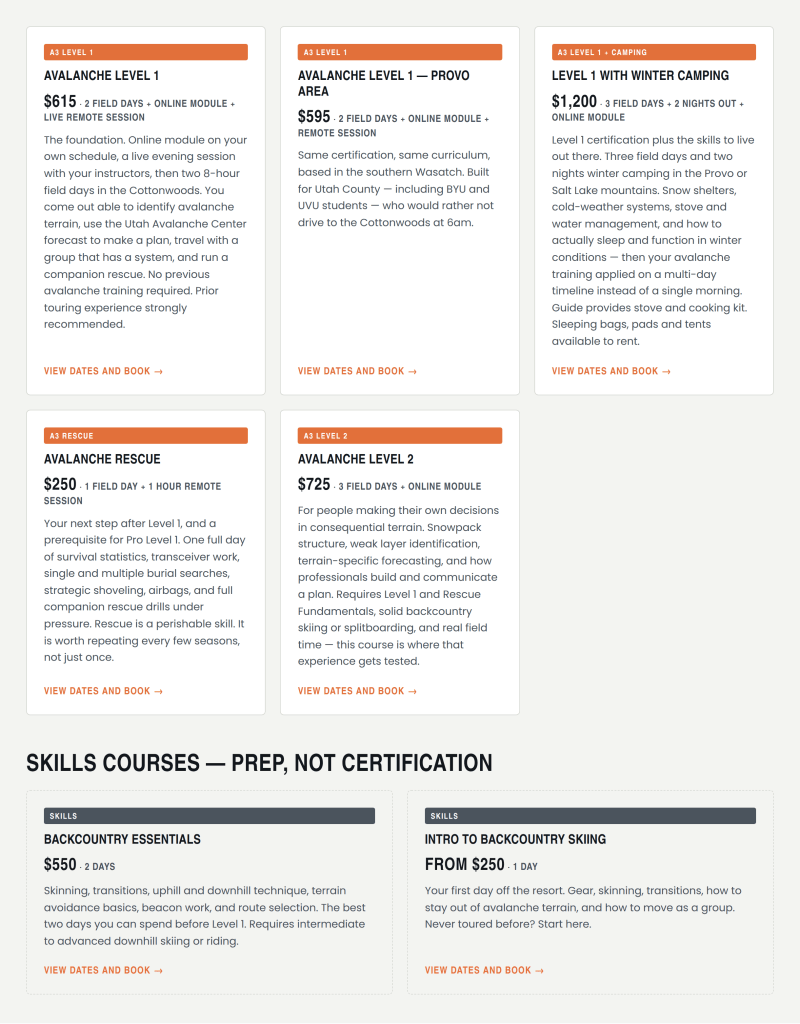
These five all carry A3 recognition and run the American Avalanche Institute curriculum, which is the same material used by professional-track programs. Whatever you take, the certificate is recognized nationally.
The full lineup. Certification courses on top, skills courses below.
Avalanche Level 1
$615 · 2 field days + online module + live remote session
This is the foundation, and for most people it’s the whole decision. You do the online portion on your own schedule, meet your instructors on a video call, then spend two eight-hour days in Big or Little Cottonwood.
By the end you can look at a slope and say whether it’s avalanche terrain, turn the Utah Avalanche Center forecast into an actual plan for an actual day, travel with a group that has a system instead of a vibe, and run a companion rescue. No previous avalanche training required. Previous touring, as above, strongly recommended.
$595 · 2 field days + online module + remote session
Identical certification, identical curriculum, based in the southern Wasatch instead. We built this one for Utah County, BYU and UVU students especially, who would rather not be on I-15 at 6am to get to the Cottonwoods. Same two field days, same online module.
$1,200 · 3 field days + 2 nights out + online module
Your Level 1 certification plus the skills to stay out overnight. Three field days and two nights camping in the Provo or Salt Lake mountains: snow shelters, cold-weather systems, stove and water management, and the unglamorous business of actually sleeping and functioning when it’s cold.
The reason it’s worth the extra days is that your avalanche training gets applied on a multi-day timeline instead of a single morning. Deciding what to ski at 9am on day one is a different problem from deciding it on day three, tired, with a forecast that’s moved. Guides bring the stove and cooking kit. Sleeping bags, pads and tents are available to rent.
One full field day plus a one-hour remote session. Survival statistics, transceiver work, single and multiple burials, strategic shoveling, airbags, and full companion rescue drills run under time pressure, because that’s the only way the skill transfers.
It’s also a prerequisite for Pro Level 1 if you’re headed that direction. Worth saying plainly: rescue is a perishable skill. Most of our guides redo the drills every season. Taking it once in 2019 is not the same as being able to do it.
For people who are already making their own calls in consequential terrain. Snowpack structure, weak layer identification, terrain-specific forecasting, and how professionals build a plan and communicate it to a group.
Requires Level 1 and Rescue, solid backcountry skiing or splitboarding, and genuine field time. That last one isn’t a formality. Level 2 is where your experience gets tested, and it’s a much better course if you bring some.
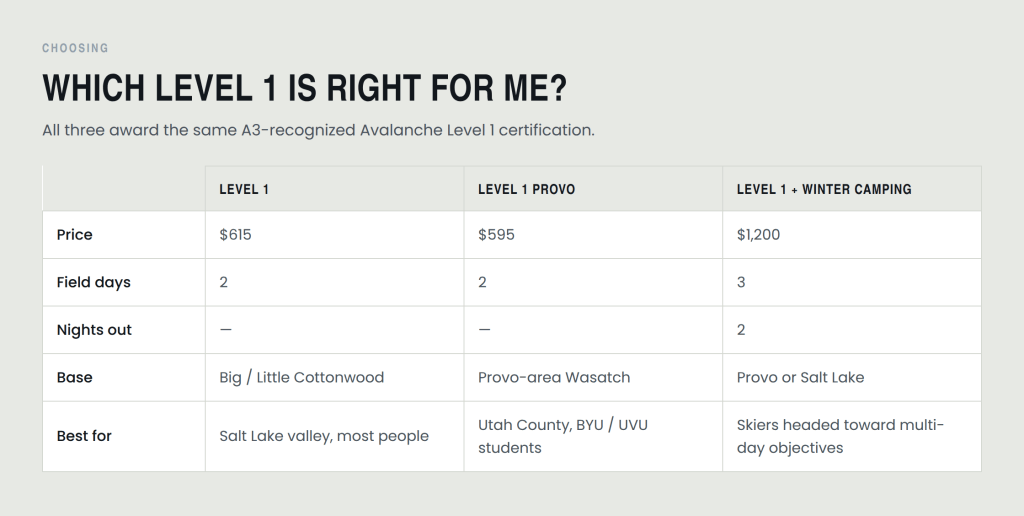
All three award the same certification. The difference is where you sleep and how many days you’re out.
Same certification, three formats.
Most people in the Salt Lake valley should take the standard Level 1. Take the Provo version if you live south and the drive is what’s going to make you skip a day. Take the winter camping version if what you’re actually building toward is multi-day objectives, because those skills are hard to pick up piecemeal and this is the cheapest way to get both at once.
What to Take Before Level 1
These two aren’t certification courses and we don’t pretend otherwise. They’re the reason some students show up to Level 1 ready to learn.
Intro to Backcountry Skiing
From $250 · 1 day
Your first day off the resort: gear, skinning, transitions, how to stay out of avalanche terrain entirely, and how a group moves together. If you’ve never toured, this is the first thing to book.
Skinning and transitions, uphill and downhill technique, basic terrain avoidance, beacon work, and route selection. The best two days you can spend before Level 1. You need intermediate to advanced downhill ability on skis or a splitboard to get much out of it.
Not eight, not twelve. You get coached, corrected and asked questions. If you dig a pit, your instructor is in it with you.
AMGA and IFMGA certified guides
The highest certification in the industry. Our instructors hold Avalanche Pro Level 2 and Wilderness First Responder on top of their guide certifications. Many of them guide the Wasatch all winter and Alaska, the Andes or the Alps the rest of the year.
A3 Recognized, AAI curriculum
Your certification is recognized nationally, and the online module is the American Avalanche Institute’s, the same curriculum used by professional-track programs.
We guide this snowpack
We don’t just teach it. The terrain you train in is the terrain we work in, in the same conditions, on the same forecast, that same week.
Why Utah Is a Serious Place to Learn This
The Wasatch has a reputation for light snow, and it earns it. It also has a continental-influenced snowpack that builds persistent weak layers, faceted snow and buried surface hoar that can sit quietly for weeks and then break wide and deep. That combination makes this range an excellent classroom and a bad place to guess.
It’s also compressed in a way that almost nowhere else is. You can go from pavement to standing underneath a loaded 35-degree start zone in under an hour. Big and Little Cottonwood hold slide paths that run to the road. Terrain traps, road closures and interlodge are ordinary parts of winter here, not exotic scenarios. Our field days use that instead of working around it.
Every course day starts the same way a guided day does: open the Utah Avalanche Center forecast and build the day from it. By the end of the course, that’s something you do, not something you watch us do.
Questions We Get Every Season
Do I need to be an expert skier?
No, but you need to be comfortable off-piste. Intermediate to advanced downhill ability and decent fitness. You’ll be skinning uphill for several hours with a pack. If you’ve never toured, take Intro to Backcountry Skiing or Backcountry Essentials first.
Is the certification recognized outside Utah?
Yes. A3 recognition is the national standard in the US, and the curriculum is the American Avalanche Institute’s.
Does it expire?
The certification doesn’t. Your rescue skills do. We suggest a Rescue refresher every two or three seasons, and most working guides run the drills annually.
What gear do I need?
A touring setup (skis or splitboard, skins, boots, poles), warm layers, and a pack. We provide beacon, shovel and probe if you need them, and a pack if you don’t have one. For the winter camping course, sleeping bags, pads and tents are available to rent.
Can I take it on a splitboard?
Yes. Splitboarders are welcome in every course we run.
Can I sign up alone?
Most students do. Courses run with a minimum of two students and a maximum of four per instructor.
What happens if the avalanche danger is high on my course day?
We teach. High danger isn’t a cancellation, it’s a lesson you can’t stage. We pick terrain to match conditions, which is exactly the decision the course is about.
Do you run private courses?
Yes, on dates you pick, for you and your partners. It’s a good option for a group that wants to train as the unit they actually travel with. Get in touch and we’ll build it.
The Honest Version of Why This Matters
Terrain doesn’t care how good your gear is, how many days you ski a season, or how long you’ve been comfortable inside a resort boundary. None of that changes what a slope does when it’s loaded.
Training is the one variable you can move. It won’t make you safe, and anyone selling it that way is selling something else. What it does is give you a process you can run on a Tuesday morning when the forecast is ugly, your partners want to go anyway, and somebody has to be the one who says the sentence out loud.
Come spend two days with us and learn how to be that person.
Level 1, Avalanche Rescue and Level 2, taught in Big and Little Cottonwood and the Provo-area Wasatch by working AMGA and IFMGA guides.